


Walk into a Victorian townhouse, a sleek modernist apartment, and a cosy Scandinavian-inspired cottage, and you’ll encounter three completely different worlds — yet all of them reflect the same fundamental human desire to make a home feel meaningful. Interior design has never been static. It shifts, evolves, reacts, and occasionally circles back on itself, shaped by everything from economic upheaval and technological progress to shifting cultural values and the way we actually live our lives.
Understanding how interior design styles have changed over time isn’t just a history lesson — it helps explain why certain aesthetics feel so instinctively right, why trends come and go, and how today’s most popular styles came to be. Whether you’re drawn to the clean lines of minimalism or the layered warmth of maximalist décor, there’s a fascinating story behind how we got here.
The Foundations: Victorian and Edwardian Excess (1837–1910)
To understand the evolution of home design, it helps to start with the era that many later movements were reacting against. The Victorian period, spanning much of the nineteenth century, was characterised by extraordinary ornamentation. Homes were filled with heavy mahogany furniture, velvet drapery, patterned wallpapers, and as many decorative objects as could be reasonably arranged on every available surface.
This wasn’t mere vanity — it was a statement. As the middle classes grew in prosperity during the Industrial Revolution, the home became a powerful symbol of status and respectability. Showing wealth meant displaying it. Dark, rich colours dominated: deep burgundies, forest greens, and midnight blues were considered sophisticated and refined.
The Edwardian era that followed (roughly 1901–1910) softened some of this heaviness. Rooms became slightly lighter, more pastel-toned, and a little more open in layout, reflecting a growing interest in fresh air and hygiene. But the instinct to fill a space remained strong.
The Arts and Crafts Movement: A Reaction to Mass Production
Running alongside late Victorian excess was a very different philosophy. The Arts and Crafts movement, championed by figures like William Morris in Britain, pushed back against the mass-produced, factory-made aesthetic that industrialisation had brought with it. Morris believed that beautiful, handcrafted objects made by skilled artisans had an inherent dignity that machine-made goods could never replicate.
In practical terms, this translated to interiors featuring hand-blocked wallpapers with natural motifs — think flowing botanicals and stylised birds — alongside handmade ceramics, exposed wooden beams, and simple, honest furniture with visible joinery. The palette was earthier and more natural than the deep Victorian tones: warm ochres, sage greens, and terracotta.
Arts and Crafts homes felt purposeful and grounded, and the movement’s influence can still be seen today in the enduring popularity of craft-inspired and artisan design.
Art Deco and Modernism: Glamour Meets Function (1920s–1940s)
The years following the First World War brought profound social change, and interior design changed with it. Two major movements emerged during the interwar period, pulling in very different directions.
The Glamour of Art Deco
Art Deco, which peaked during the 1920s and 1930s, embraced boldness and luxury. Geometric patterns, mirrored surfaces, lacquered furniture, and materials like chrome, glass, and exotic veneers defined the style. Colours were striking — jet black paired with gold, deep jewel tones, and stark contrasts.
Art Deco was unapologetically glamorous and reflected the optimistic, fast-paced energy of the Jazz Age. It appeared everywhere from grand hotels and cinemas to domestic interiors, particularly in wealthier homes. Even today, Art Deco-inspired details — a geometric light fitting, a mirrored console table, chevron-patterned flooring — feel effortlessly sophisticated.

The Rise of Modernism
Meanwhile, a more radical shift was underway. The Bauhaus school in Germany, founded in 1919, championed the idea that form should follow function. Decoration for its own sake was considered wasteful and dishonest. Instead, modernist interiors stripped everything back to essentials: flat-pack furniture that could be produced affordably, open-plan layouts, large windows that brought the outside in, and materials chosen for their practicality.
Architects like Le Corbusier famously declared that “a house is a machine for living in” — a statement that captured modernism’s utilitarian spirit perfectly, even if it occasionally produced spaces that felt a little cold in practice. Understanding how to balance form and function remains one of the central challenges of home design to this day.
Post-War Domesticity: The 1950s and 1960s
After the austerity of the Second World War, there was a collective exhale. New homes were being built at speed, consumer goods were becoming accessible to ordinary families, and there was an infectious optimism about the future — particularly in Britain and America.
1950s interiors reflected this mood. Pastel colour schemes — mint green, baby pink, sunny yellow — paired with practical Formica surfaces and new synthetic materials. Furniture became lower-slung and more relaxed in silhouette. The kitchen became a central room in the home rather than a purely functional back-of-house space, reflecting women’s changing domestic role and the rise of labour-saving appliances.
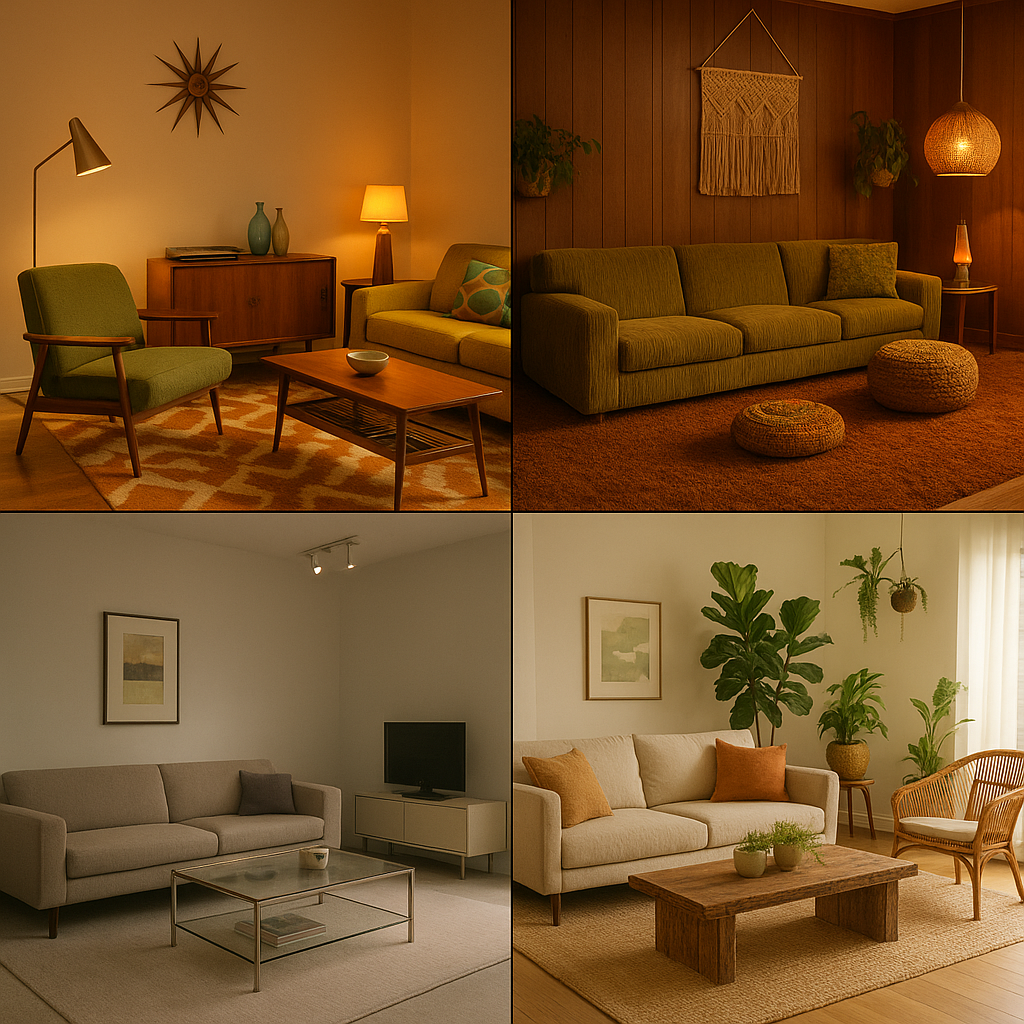
The 1960s pushed further into experimentation. Space-age design, influenced by the excitement of the moon landing era, introduced futuristic shapes: egg chairs, lava lamps, bold geometric prints, and colours like burnt orange, avocado green, and harvest gold. Open-plan living became more mainstream, breaking down the formal room divisions that had characterised earlier home layouts.
Minimalism and the Clean Aesthetic: 1980s to 2000s
By the 1980s, design had swung into a more maximalist phase — marble, glass, gold fixtures, and an emphasis on overt luxury. But this was followed in the 1990s and early 2000s by a decisive move towards minimalism. White walls, bare floors, streamlined furniture, and the deliberate removal of clutter became the aspirational look.
This wasn’t merely aesthetic preference. The minimalist movement reflected broader cultural conversations about simplicity, intentionality, and the growing sense that modern life had become overwhelmingly cluttered — not just physically, but mentally. Design writers like John Pawson articulated a philosophy of reduction: that stripping a space back to its essential elements could produce something more beautiful and more liveable than filling it.
The rise of IKEA as a global design force during this period was significant. Affordable, flat-pack furniture with clean Scandinavian lines made modernist principles accessible to virtually everyone, democratising good design in a way that would have astonished William Morris.
The Influence of Scandinavian Design: Hygge and Beyond
Scandinavian design deserves its own mention, having exerted an outsized influence on interior aesthetics worldwide — particularly since the early 2000s. Rooted in a philosophy of simplicity, functionality, and connection to the natural world, Scandinavian interiors balance clean lines with warmth in a way that feels both sophisticated and genuinely liveable.
The Danish concept of hygge — roughly translated as cosiness, comfort, and convivial wellbeing — became a mainstream talking point in Britain and beyond around 2016, influencing everything from candle sales to the popularity of natural textures like wool, linen, and raw wood. The Scandinavian palette of whites, greys, and soft naturals, layered with tactile textiles and low, warm lighting, proved universally appealing. For those drawn to this aesthetic, balancing minimalism with warmth is key to achieving a result that feels inviting rather than stark.
Contemporary Design Styles: Where Are We Now?
Today’s interior design landscape is arguably more varied and democratic than at any previous point in history. Rather than one dominant style dictating what a home should look like, there are multiple competing aesthetics, and homeowners increasingly mix and match to create spaces that feel personal and specific.
Biophilic Design
One of the most significant current trends is biophilic design — the deliberate incorporation of natural elements into interior spaces. Houseplants, natural materials like rattan and jute, stone surfaces, and large windows that connect interior spaces to the outdoors all reflect growing research into the psychological benefits of contact with nature. Studies suggest that biophilic design can reduce stress and improve wellbeing, making it one of the more evidence-backed trends in contemporary design.
Maximalism’s Return
After years of minimalist dominance, maximalism has made a confident comeback. Bold colour choices, pattern clashing, gallery walls, collections of objects displayed with intention — these have all become increasingly celebrated. Designers and homeowners are pushing back against spaces that feel too sanitised, too “showroom-perfect,” in favour of interiors that feel lived-in, characterful, and genuinely reflective of the people who inhabit them.
Sustainable and Vintage-Led Interiors
Environmental awareness has also reshaped how people think about furnishing their homes. Buying secondhand, investing in quality pieces that will last rather than fast-furniture that won’t, and choosing natural, sustainably sourced materials have all gained significant traction. The vintage and antique market has surged in popularity, with younger homeowners in particular embracing the character and sustainability credentials of pre-owned pieces.
What Interior Design Styles Say About Us
It’s worth pausing to note that interior design has never been purely about aesthetics. Every dominant style reflects the values, anxieties, and aspirations of the society that produced it. Victorian excess spoke of newly acquired prosperity and a desire for status. Modernism reacted against waste and embraced democratic ideals. Minimalism responded to overwhelm. Today’s eclectic, sustainability-conscious approach reflects concerns about the environment and a rejection of one-size-fits-all solutions.
This is why understanding design history can be genuinely useful when thinking about your own home. Knowing where a style came from — what it was reacting to, what values it embodies — helps you make more intentional choices about what you bring into your space and why.
Conclusion
Interior design styles have never evolved in a straight line. They zigzag between excess and restraint, between ornament and function, between individual expression and collective aspiration. From the heavy drapes of Victorian parlours to the plant-filled, light-flooded rooms of today’s biophilic interiors, each era has left something behind in the way we think about home.
What’s clear is that good design, in whatever form it takes, has always been about more than surfaces. It’s about how a space makes you feel, how it functions for the people living in it, and what it communicates about the values of its time. The styles may change — and they will continue to change — but that fundamental ambition stays constant.
Whether you’re drawn to the clean geometry of Art Deco, the cosy layering of Scandinavian style, or the expressive abundance of maximalism, you’re participating in a long, rich conversation about what it means to make a place feel like home.